How PlotWeaver and the Nigerian Film Corporation Are Building Language Infrastructure for Africa’s Film Industry
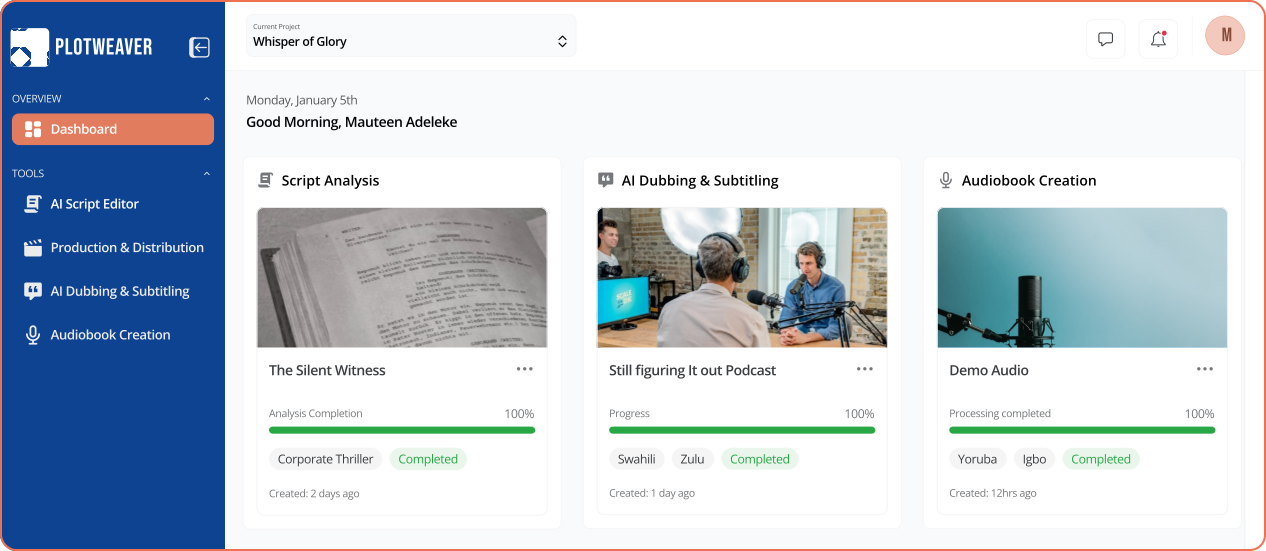
In January 2026, PlotWeaver and the Nigerian Film Corporation announced a partnership that signals a major shift in how African films are created, distributed, and understood. Beginning in February, the NFC will introduce AI-assisted film planning training for Nigerian filmmakers and students. On the surface, this looks like a technology collaboration. In reality, it represents something much bigger: institutional recognition that language infrastructure is essential to the future of Africa’s creative economy.
Nollywood produces more than 2,500 films each year, making it one of the most prolific film industries in the world. Yet the overwhelming majority of these stories never travel beyond their original language audience. A Yoruba film, for example, may resonate deeply with millions of viewers, but its potential audience across Hausa, Swahili, Igbo, Akan, and Zulu markets remains largely unreachable. The barrier isn’t creativity or demand, it’s infrastructure. That limitation translates into an estimated $2.3 billion in unrealized annual revenue across African cinema, where great stories are confined not by quality, but by language.
Traditional dubbing was never designed to scale across a continent as linguistically rich as Africa. Each language version can cost more than many independent productions can afford, with timelines stretching weeks or months. For most filmmakers, expanding into multiple language markets simply isn’t viable. As a result, even films with global appeal remain locked inside single-language ecosystems, limiting reach, impact, and revenue.
PlotWeaver approaches this challenge as an infrastructure problem rather than a production expense. By combining AI-driven dubbing with research-backed language modeling, the platform dramatically reduces the time and cost required to localize films while preserving tone, emotional delivery, and cultural nuance. The system is built on more than 700 hours of research-grade multilingual speech data validated by African universities and native speakers — a foundation designed to capture how language actually lives in conversation, not just in translation.
This infrastructure shift changes the economics of distribution. Films that once required massive dubbing budgets can now reach multiple language markets within days instead of months, making pan-African releases structurally possible for independent filmmakers, not just major studios. Stories that were once limited to regional audiences can travel across borders while retaining authenticity.
The Nigerian Film Corporation’s involvement is a powerful signal to the industry. Government-backed institutions rarely integrate emerging technology into national training frameworks unless it represents durable, long-term value. By embedding AI-assisted planning and dubbing workflows into filmmaker education, the NFC is effectively declaring that multilingual accessibility is no longer optional; it is foundational. Future filmmakers will plan distribution across languages from the earliest stages of production, reshaping how African content is conceived and delivered.
Looking ahead, the implications are transformative. A film created for a single linguistic audience today could soon launch simultaneously across multiple African markets without multiplying its production budget. The same story, the same creative vision, but with exponentially broader reach. This is not about replacing artistic processes; it is about removing structural barriers so African stories can circulate as freely as the audiences that want them.
At its core, the NFC–PlotWeaver partnership recognises a simple truth: language is infrastructure. Just as electricity and internet connectivity enable industries to grow, scalable multilingual communication enables stories to travel. Nollywood does not need to produce ten times more films to reach ten times more people. It needs the systems that allow existing stories to cross linguistic borders naturally.
That infrastructure is being built now. And as African cinema enters its next phase of growth, the ability to localise content at scale will determine which stories and which organisations define the continent’s creative future.
PlotWeaver is building language infrastructure for African stories to reach the world.
Never Miss an Update!
Get monthly insights on African AI, cinema, and our journey building in public